


ART & BUSINESS · ANALYSIS
How an anonymous street artist built one of the most valuable brands in contemporary art – without a name, a gallery, or a single press interview.
Published on ZenGate · 2026 · 4 min read.
The Paradox
The most commercially successful street artist in history has never shown his face. Has never given an interview. Has no verified social media presence, no gallery representation, and no legal name attached to his work.
And yet Banksy commands auction prices comparable to Damien Hirst and Jeff Koons. His Instagram account – run entirely on his own terms – exceeds 11 million followers. A single work sold for £9.9 million at Sotheby’s. The authentication service he controls, Pest Control, is the gatekeeper to a market worth hundreds of millions.
This is not an accident. This is a business model.
What He Actually Built
Most people see the art. The stencilled rats. The girl with the balloon. The riot policeman with a smiley face. The social commentary spray-painted onto walls that weren’t his.
What is harder to see is the infrastructure behind it.
Banksy built three things simultaneously: a brand, a scarcity system, and a trust layer.
The brand is the anonymity itself. Mystery creates attention. Attention creates demand. Demand without a face to attach it to becomes something rarer – it attaches to the work instead.
The scarcity system is controlled through limited print editions, unpredictable release schedules, and the deliberate destruction of a work mid-auction – the most famous being the shredding of Girl with Balloon moments after it sold for over a million pounds. Rather than destroying value, the act doubled it.
The trust layer is Pest Control – the official authentication body that verifies whether a work is genuinely Banksy’s. Without it, the market collapses. With it, collectors can transact with confidence despite the artist’s complete anonymity. It is, essentially, a blockchain without the technology – a single source of truth controlled entirely by the artist.
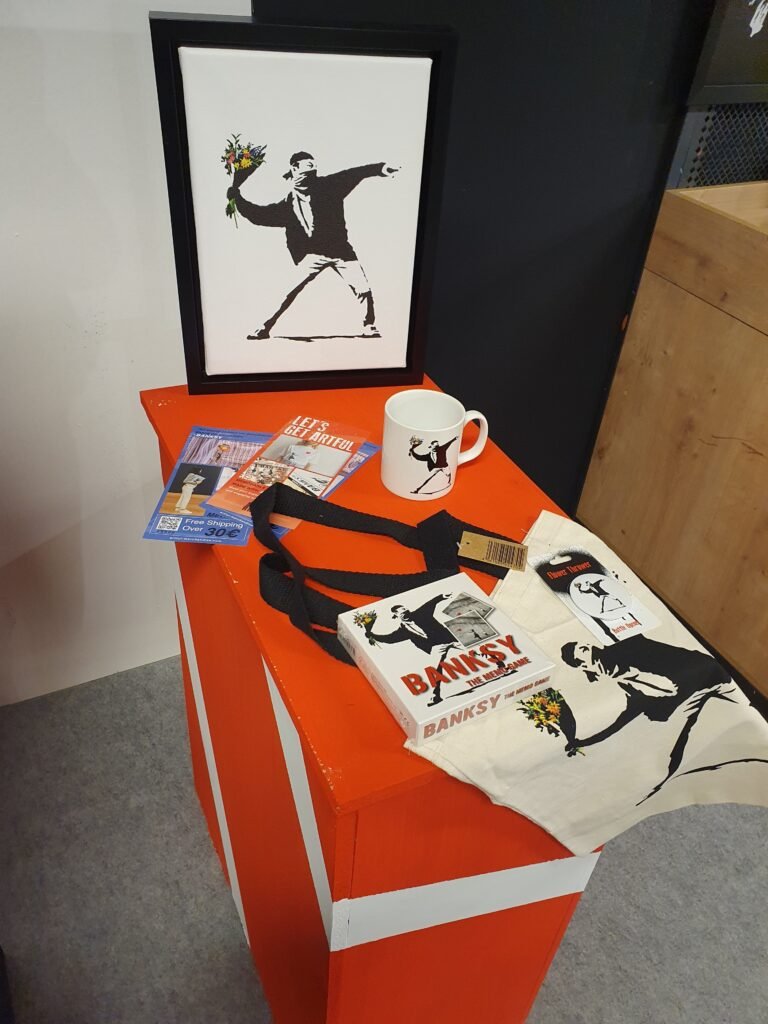
By Joehawkins – Own work, CC0, https://commons.wikimedia.org/w/index.php?curid=185146596
The Business Model Nobody Talks About
Banksy is regularly described as anti-establishment, anti-commercial, anti-capitalist. The work says as much. And yet the commercial operation behind it is more sophisticated than most art market participants would admit.
Multiple revenue streams operate in parallel: original works selling at auction for seven and eight figures, limited edition prints ranging from a few hundred to tens of thousands of pounds, book sales in the millions, documentary licensing, and merchandise that walks the line between official and unofficial.
The Dismaland installation in 2015 – a dystopian parody of a theme park built in a derelict lido in Weston-Super-Mare – attracted over 150,000 visitors and generated an estimated £20 million in economic activity for the local area. It was presented as anti-consumerist commentary. It was also one of the most effective marketing activations in contemporary art history.

What This Means Beyond Art
The Banksy model contains a lesson that applies well beyond the art world.
The most defensible brand position is not the loudest or the most visible. It is the most specific and the most consistent. Banksy has maintained the same values, the same aesthetic, and the same relationship with his audience for thirty years. The mystery has never been broken. The commentary has never softened. The scarcity has never been diluted.
In a world where most brands chase reach, Banksy built depth. And depth, over time, is worth more.
One Final Observation
The one-line verdict from a recent intelligence analysis of Banksy put it precisely: an anonymous street artist who built a $50M+ art empire by weaponizing mystery and anti-establishment messaging into the ultimate art market arbitrage play.
Arbitrage is the right word. He found the gap between where the art world assigned value and where the market was willing to pay – and he occupied that gap so completely that no one else has been able to follow.
That gap is still there. And it is still his.
This article references intelligence data generated using CGEN – c93n.com Published on ZenGate as an independent editorial piece




Leave a Reply