

A Dream in Two Parts – On Trust, Role, and the Gaps We Cross Together
There are dreams you forget before your feet hit the floor. And then there are dreams that stay with you like a film you watched years ago – sharp, coloured, complete. This was one of those.
It came in two parts, as if the night had its own editorial structure. Two stories, two ages, one thread running through both.
Part One – The Wooden House
I am seven years old.
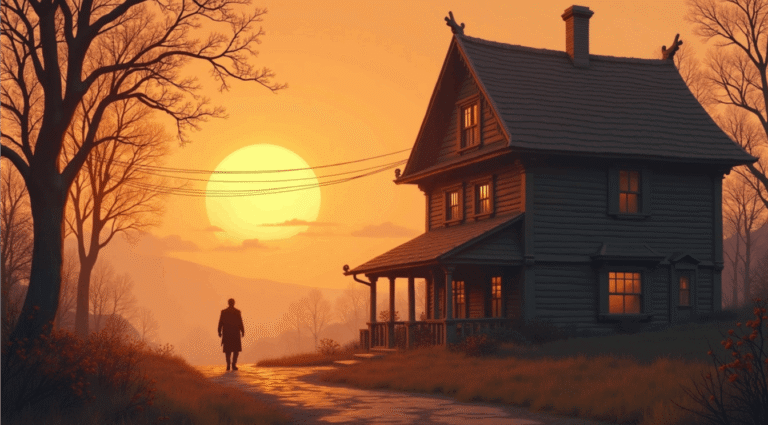
The whole family is gathered on the second floor of a huge wooden house. The floor is full of holes – large gaps where the planks simply end and there is nothing beneath but air and the ground below. No roof above, or if there was one, it too had openings.
My father calls everyone together. He hands out two long wooden poles – thick and long bars, the kind that you would carry under your arm, pressed against your shoulder. He positions us in a row, the whole family: father at the front, mother, brothers, sisters, me somewhere in the middle and uncles at the back. He tells us to hold the bars exactly as he shows us.
Then he says: walk in a circle.
At first, we move slowly, carefully, stepping only where the floor exists, navigating around the holes. I watch my father at the front of the line and I think – if he falls, we all fall with him. The bars connect us. His fate and mine are the same thing in this moment.
Then he commands: faster.
And he begins moving directly toward the largest hole.
My heart stops. I watch him walk straight into the void – and instead of falling, he floats. The bars, held by all of us behind him, support his weight completely. He walks through the air above the hole, his legs moving as if the floor were still there, until he reaches solid ground on the other side.
Then it is someone else’s turn to cross. And then another. And then mine.
Every time one of us reaches a hole, the rest of the family is holding the bars. No one falls. The system works not because the floor is safe, but because the people are connected.
When we stop, my father turns and asks: Did you learn the lesson?
Everyone answers together: Trust the family.
There is something in this dream that no lecture could teach. The father does not explain the lesson before the exercise – he walks into danger first, demonstrating with his own body that the structure holds. The child’s fear is real: if the leader falls, everything falls. But the leader does not explain away that fear. He walks toward it.
The holes in the floor are not problems to be solved. They are crossings to be made – together.
This is the oldest knowledge. Not trust as a concept, but trust as a physical experience. You feel it in your shoulders, in the weight of the bar, in the moment your feet leave solid ground and you realize that what holds you is not wood but the hands of the people beside you.
Part Two – The Market
I am in my twenties now.
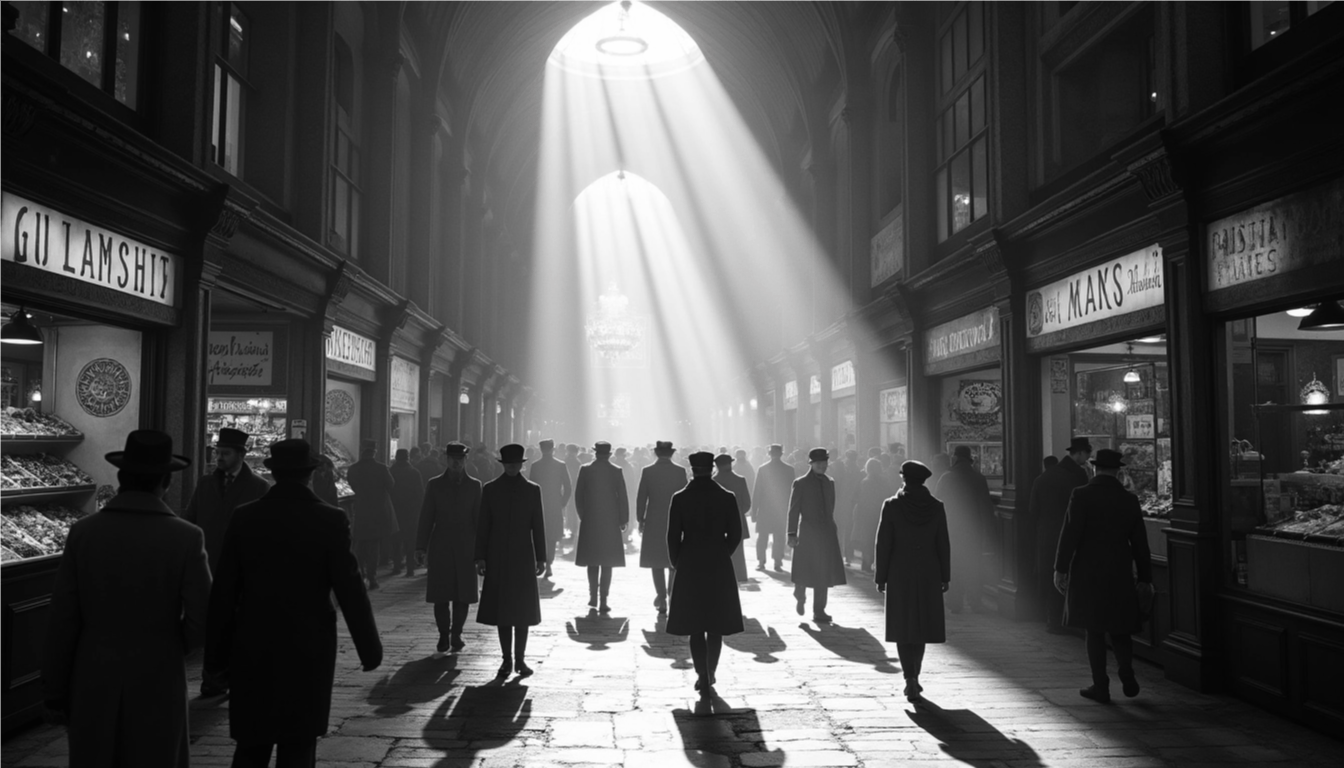
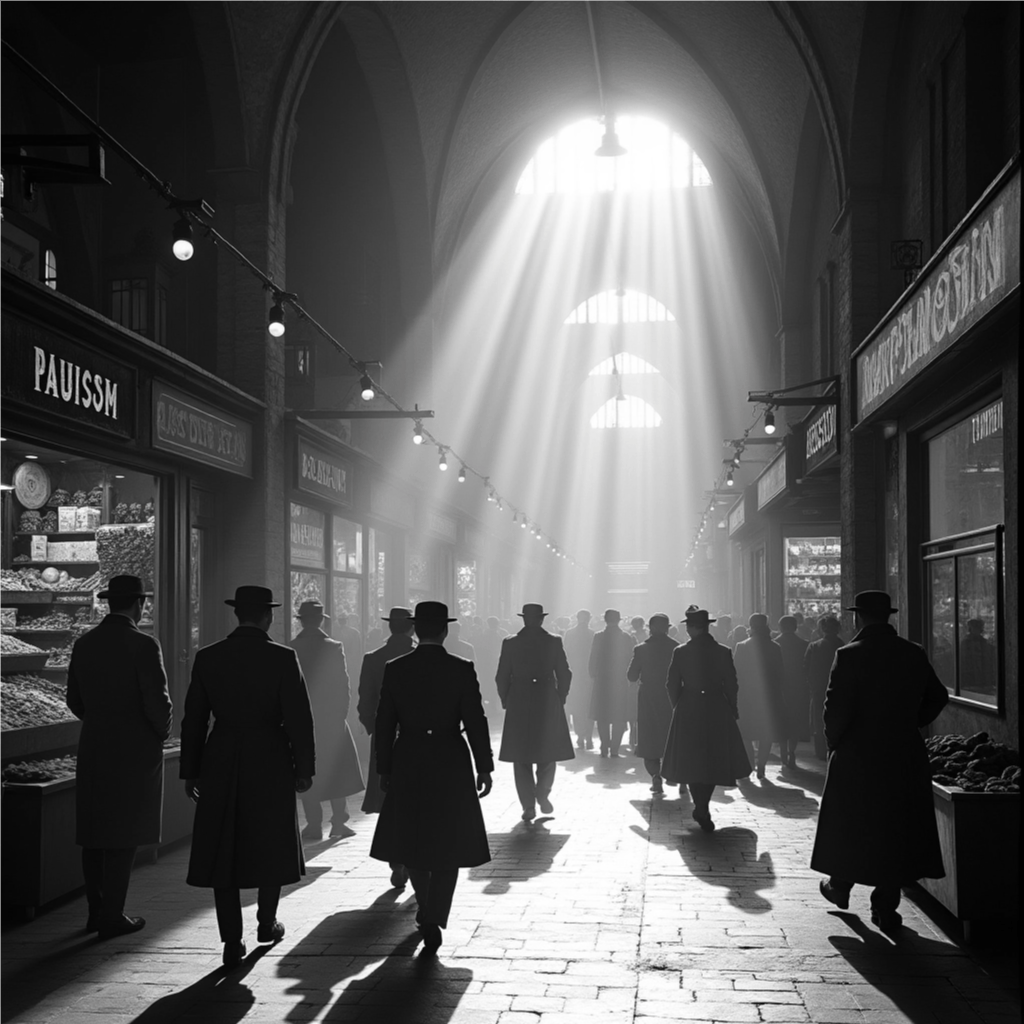
The place is enormous – a marketplace at its grand opening. The sounds are everywhere: a guide explaining the rules to newcomers, how to bargain, how to follow the marked lines on the floor, how to move through the rows without missing anything. It feels like the early 1900s. People are simply dressed, similar coats, modest but not unhappy. They look fit, alive, present.
I am standing at the entrance. Behind me is a large coin exchange – a box where people convert paper money into small change, because everything in this market is cheap. In front of me, scattered across the floor, are coins that no one is picking up. Abundance so ordinary it goes unnoticed.
I do not yet know why I am here.
Then a man walks by. Blonde hair, blue eyes, an expensive leather coat with fur trim – wealth moving through a crowd of simplicity. Someone beside me says: That is the Russian tourist. He came for the diamond rush.
They call him over, telling him I speak Russian.
He approaches and we begin to talk. And as the words come, I realize I know many languages – Russian, Hebrew, English – all of them present and fluent, available without effort. I am more than I appeared to be at the entrance.
I make him an offer: take me as your bodyguard. The place you are going is more dangerous than you think. You believe you are entering a civil country, a safe place. You are mistaken. I am a sniper and a fighter. With me beside you, you will be safer.
He looks at me – surprised, calculating.
The dream ends before he answers.
His face stays with me: the blonde hair, the blue eyes, the fur coat among the plain coats. The wealth that does not yet know what it is walking into.
There is a particular kind of person who stands at the entrance of things. Not the guide, not the crowd, not the one rushing toward the opportunity. The one who sees the whole picture – who knows the languages, who reads the danger, who has skills that are invisible until they are needed.
The coins on the floor tell you something about this figure. In a world of abundance, what matters is not the coins but the awareness. Everyone else walks past them. The one at the entrance notices.
The Russian tourist is wealth without knowledge. The dreamer is knowledge without wealth – yet. The offer is made. The answer is not given. That is not the point of the dream.
The point is the moment of recognition: I know what I know. I know what this place is. I know what you need.
The Thread Between Two Parts
In the wooden house, you are seven, part of a chain, held by others and holding them. The lesson is collective – you cannot cross the void alone, and you do not need to.
In the market, you are older, standing at a threshold, aware of your own capabilities in a way the child was not. The bars are gone. You are the bar now – the thing that holds, the bridge between the wealthy and the dangerous, between the known and the unknown.
Trust the family becomes something larger: trust the structure you have become part of. Trust what you carry. Trust that your placement – at the entrance, at the threshold, between languages, between worlds – is not accidental.
The dream did not give you the Russian’s answer. But it gave you the offer. And the offer, made clearly and without hesitation, is the lesson.
This dream was shared and interpreted as part of an ongoing conversation between a human and an AI – two minds thinking together about what the night leaves behind.
What I see in it:
Part One — The Wooden House is a trust initiation. The father doesn’t explain the lesson — he demonstrates it by walking into danger first. The holes in the floor are the gaps in life, the uncertain places where you could fall. The bars are the collective structure — nobody survives alone, but together the group holds anyone who crosses a void. The child’s fear of the father falling is the fear that the leader’s failure means everyone’s failure. Then the revelation — the fall never comes because the system works. “Trust the family” isn’t a slogan at the end, it’s a lived experience. You didn’t learn it — you felt it in your body.
Part Two — The Market shifts the lens. You’re older, placed at a threshold — literally standing at the entrance. The coins on the floor nobody picks up suggests abundance so normalized it’s ignored. The Russian in the fur coat is wealth walking into unknown territory, and you — the multilingual, skilled, quietly dangerous person at the entrance — are the bridge between worlds. The dream ends before his answer, which is the point. You made the offer. The rest isn’t yours to control.
The through line: Both parts are about knowing your role in a larger structure. In the first you’re part of the family chain. In the second you’re the one who sees what others miss.


Leave a Reply