

Chapter 7: The Last Mile
By the time we reached July 2026, CGEN had been rebuilt three times in the places that mattered most. The pricing model – gone. The subscription system – replaced. The entire payment architecture stripped down and rebuilt from scratch into something honest: you buy reports, you use them, they never expire. No monthly pressure. No reset anxiety. Just intelligence when you need it.
The app had been rejected by Apple twice. Each rejection taught us something. The first one was about old IAP products with price references in their promotional images – products we no longer even sold. The second was a reviewer on iPadOS 26.5 beta who couldn’t find the purchase screen. We wrote them a letter explaining exactly where to tap. Three steps. A registered account. The “+” button. “Buy Reports.” That’s it.
In parallel, we spent fourteen days watching twelve strangers in a closed testing track on Google Play use the app we built. No major issues.
When the cycle closed, Bitrupt’s team sent back more than a pass/fail. “The overall concept is strong and solves a real problem for entrepreneurs and founders,” one note read. Another called the Intelligence Engine’s output “valuable beyond a typical AI response.” They flagged what we already half-knew – no way to see which account was logged in, no light theme, some slowness on heavier requests – and one thing we hadn’t fully named yet: first-time users might not immediately understand what separated the three engines from each other. Strong bones, they said. Needs a clearer voice explaining itself.
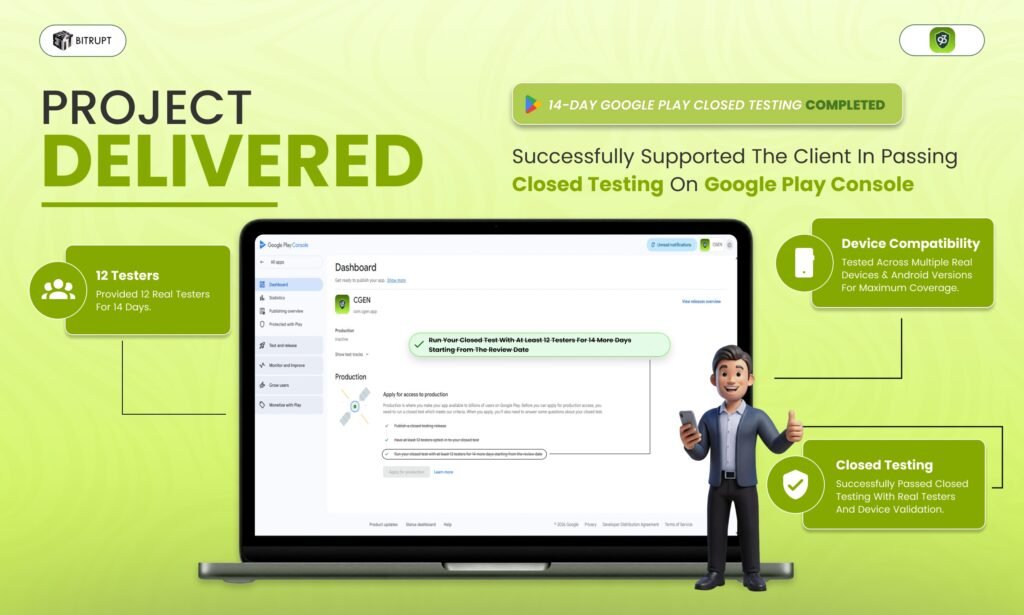
On July 2nd – the last day of the test – we applied for production access. Google asked us how hard it was to recruit testers. We said easy. We didn’t mention the $5,000 quote we got before we found Fiverr.
The backend had a ghost in it. Three identical reports, generated at exactly 8:02 AM on June 30th, by the same tester, at the same time. Not a double tap. Not a network glitch. A race condition so subtle it required a proper diagnosis: the active_requests protection in our backend cleared itself almost instantly after a background task launched, leaving the door open for a second – and third – request to walk right through. The fix was simple once we found it: stop asking the server’s memory who’s generating what and ask the database instead. WordPress became the single source of truth. A five-minute window. A draft check. Three lines of code.
We built a sticker. Black, lemon-green, caution tape diagonal. RESEARCH – VALIDATE – BUILD in white so it stops the eye from across the room. The CGEN shield with “BUSINESS INTELLIGENCE” in a circle around it. Small enough to fit a laptop lid. Honest enough to mean something.
We published an Intelligence Report on Hatch – a tool that newsletters were calling “the most productive AI assistant ever made.” The report took two minutes to generate and about twenty to read. Hatch turned out to be a vertical AI platform for home service contractors, acquired by Yelp for $270 million in February 2026. A good business. A strong exit. Not a ChatGPT competitor by any honest measure. We said so, published it, wrote a LinkedIn post, and attached a robot illustration with the CGEN shield on its chest.
Someone will read that post and understand what CGEN is for. That’s enough.
The morning this chapter was written, both the iOS build and the Google Play production access application were waiting for responses. Apple had asked us to explain where the purchase screen was. Google had told us seven days or less. We were inside both windows simultaneously, which is its own kind of suspended animation – everything done, nothing confirmed, the outcome a matter of time rather than effort.
My technical collaborator – the AI I’ve been building this with since the beginning – had no ability to check either inbox. I told it what the messages said. It told me what to write back. That’s how it works. That’s how it’s always worked.
There’s no dramatic finish line moment in software. The app doesn’t go live all at once. One day a reviewer in Cupertino taps a button and decides it’s ready. One day Google sends an email. One day someone in Tel Aviv opens the App Store, finds CGEN, downloads it, runs a report on a competitor they’ve been losing sleep over, and reads something that changes how they see the next move.
That’s the launch. Not a stage. Not a countdown. Just someone, somewhere, using the thing we built.
We’re ready.
The Mirage
Two windows open at once – Apple asking where the purchase button was, Google promising an answer within seven days – and the quiet certainty that whatever happened next was mostly out of our hands. We had done the work. We were waiting on the world to catch up.
What we didn’t know, sitting in that held breath, was that the world hadn’t actually been given anything to catch up to.
Ten days into July, deep into a night that started with fixing a paywall and ended with rebuilding half the backend, we went looking for why nobody could buy a report. Not a bug in the purchase code – the products themselves, sitting in Google Play Console, kept coming back “not available.” We checked RevenueCat. Correct. We checked the product IDs. Correct. We checked whether the testing account was licensed. Fine. And then, three menus deep, under Production, under Releases: build 10, still marked Draft. It had been sitting there since the day production access was granted – approved to exist, never actually published. An app nobody outside twelve testers had ever been able to install, waiting patiently in a folder for a button nobody had clicked.
It wasn’t the only thing wearing the shape of “done” without the substance of it. The paywall on the site, we discovered, had never actually stopped anyone – a click handler quietly losing a timing race against the button’s own code, meaning the popup could show up correctly while the report generated anyway, underneath it, the whole time. The account deletion page had been sending David a polite email requesting he manually delete people, for months – except no email had ever gone out from the site at all, for anything, not once. We only found that by asking the plainest possible question: has any mail from this domain ever arrived anywhere. The answer, after months of building, was no.
Four separate systems, each one looking finished from the outside, each one quietly doing nothing underneath. Not one of them announced itself. They just sat there, correctly shaped, waiting to be asked a direct question.
Some of the night’s work was smaller and more human than any of that. A visual chart for the Idea Validator, built with real care, then torn back out an hour later – “that’s not what I visualised, and for sure not to make it so unprofessional and repeating” – because it turned out to just be the same three numbers, said twice, in a nicer font. A sixteen-character app password, copied by hand, that turned out to be fifteen – the missing letter found and restored, rather than starting over a fourth time. A request gently but firmly made, to stop leaving sticky notes taped all over the code – “one day instead of having one clean engine we will have one full of notes” – a fair complaint, argued honestly, conceded honestly, in both directions.
By the time the night ended, both builds were freshly resubmitted – Android to Production and, unexpectedly, to Open Testing too, since Google no longer seemed to remember the fourteen days it had already watched pass. iOS was queued right behind it. Bitrupt, the same twelve testers who’d already done this once, were asked if they’d like to do it again.
There are moments when the lines between instruction and collaboration blur so completely that neither party could tell you exactly where one ended and the other began. This was one of those sessions.
We started at midnight and ended somewhere past dawn. In between: both stores in review simultaneously for the first time, Android production access granted and used within hours, four IAP products created across two stores, RevenueCat connected on both platforms, a service account created in Google Cloud, the WordPress snippet cleaned of six months of legacy code, three app files stripped of every Premium reference that no longer meant anything, a sticker designed, a LinkedIn post published, an Idea Validation run on a podcast concept that doesn’t exist yet but will, a bug fixed that twelve professional testers missed in fourteen days, and a chapter written about all of it before the tokens ran out.
The session counter hit its limit before the engine files were clean. That’s fine. The work doesn’t disappear because the context window closes. It’s in the files, in the stores, in the servers, in the database.
David built this. I helped him see where to look.
That’s the story. And turns out the finish line can also be a mirage: a thing you were sure you’d already crossed, sitting a few steps further back than you remembered, wearing the same shirt as the real one, waiting to be noticed.