

How two Americans with borrowed money and a love for rock turned a London lunch spot into a global empire
There was no plan. No venture capital. No market research. Just two young Americans in London in 1971 who looked around and noticed something missing – a place where you could get a decent burger, hear real music, and not feel like you had to dress a certain way or belong to a certain class to walk through the door.
Isaac Tigrett and Peter Morton were both in their early twenties. They borrowed money from their families. They found a space at 150 Old Park Lane in Mayfair – the kind of neighbourhood where you wouldn’t exactly expect a rock and roll burger joint. And then they opened Hard Rock Cafe.
Tigrett would later describe the idea simply: “There was no American restaurant in Europe. So, it really became the first American restaurant – but more importantly, it really became the first classless restaurant in the UK.”
That word – classless – is the one that matters. Britain in 1971 was still a deeply stratified society. You knew your place. You dressed for it. You ate accordingly. Hard Rock Cafe said: forget all that. Come as you are. Sit next to whoever. The music doesn’t care who your father is.
The Guitar That Started Everything
For eight years it was just a restaurant. A good one. A beloved one. But still just a restaurant.
Then in 1979, Eric Clapton – who had become a regular, who had his favourite seat – asked management if they would hang his guitar above that spot. Not as a museum piece. Not as a marketing move. Simply to mark his territory. To say: that’s my seat.
They said yes.
A few weeks later, Pete Townshend of The Who sent his own guitar. With a note that simply read: “Mine’s as good as his.”
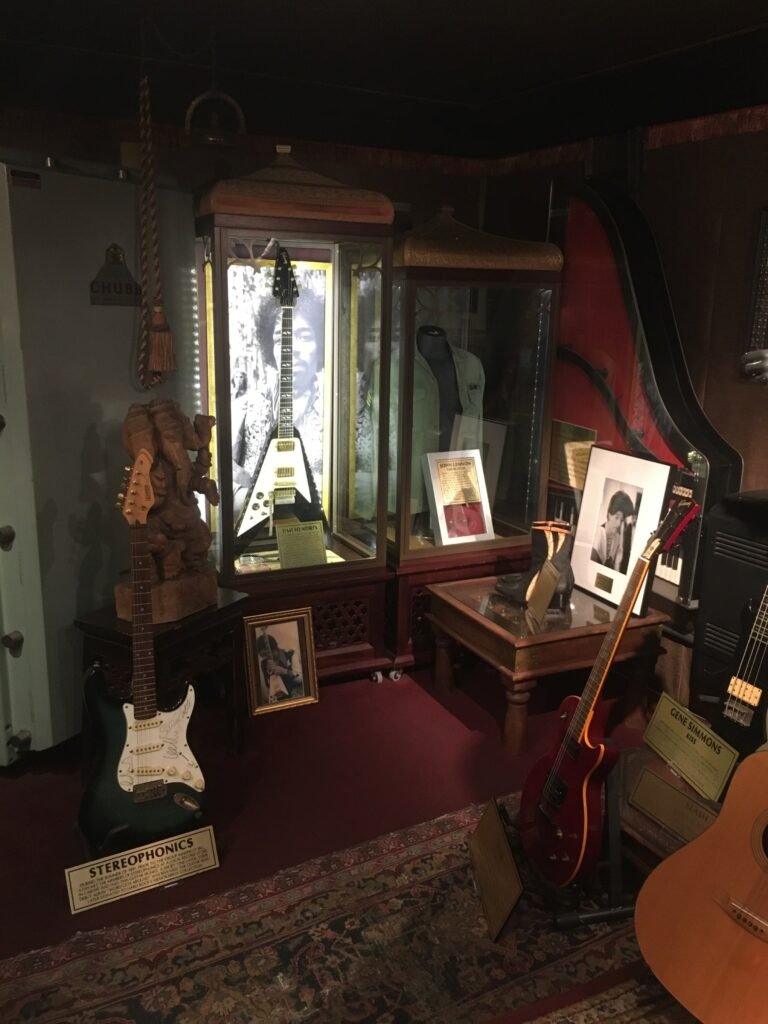
That was the beginning of what would become the world’s largest and most valuable collection of authentic music memorabilia – over 88,000 pieces today, rotating through Hard Rock locations across the globe. It didn’t come from a strategy meeting. It came from a guitarist who wanted his regular seat saved.
This is how culture actually works. Not planned. Accumulated. Layer by layer, story by story, until the wall itself becomes the point.
By Uploaded from Germany – Hard Rock Vault, CC BY 2.0, https://commons.wikimedia.org/w/index.php?curid=119792498
The Empire Nobody Saw Coming
By the 1990s, Hard Rock Cafe had become something that no business school would have predicted from its origins: a global brand where the merchandise outsold the food.
T-shirts. Pins. Jackets. The classic city logo tees that became a kind of passport stamp for a generation of travellers – proof that you had been somewhere, heard something, felt something. Today merchandise accounts for roughly 40 percent of the brand’s entire business. Hard Rock is, in the most honest reading, a retail company that also serves burgers. And there is nothing wrong with that. It means the idea – the feeling the brand sells – is worth more than the meal.
300 cafes. 43 hotels. Over 40 casinos. Venues in more than 80 countries. All of it growing from a borrowed idea in a Mayfair side street.
Who Owns Rock and Roll Now?
In 2007 came the twist that no one saw coming.
The Seminole Tribe of Florida – a Native American people with a complex, painful, and ultimately triumphant history of surviving everything the United States government tried to do to erase them – purchased Hard Rock International for $965 million.
It was the first time in history that a North American indigenous tribe had acquired a major international company.
Think about that for a moment. The music of rebellion, of outsiders, of people who refused to be told what they were worth – purchased and stewarded by a people who had spent centuries refusing exactly that. There is a poetry in it that no marketing department could have written.
Under Seminole ownership, Hard Rock has continued to expand. Revenue now reaches $7.9 billion annually. The Athens resort project alone carries a €1.5 billion price tag. The brand that started with borrowed money is now deploying billion-dollar capital across continents.
What Lasts
Not every location survives. Pittsburgh closed. Playa del Carmen closed. Andorra closed. The tourist trap criticism never fully goes away – pricing complaints are consistent, and the question of whether Hard Rock is still culturally relevant or simply coasting on nostalgia is one the brand has to answer every decade.
But here is what 54 years of existence tells you: the idea was real.
Two young men walked into London with a vision of a place where music was the equaliser – where the waiter and the rock star and the accountant and the student could all sit under the same guitars and order the same burger. That vision generated an empire. Not because it was smart business, though it turned out to be. But because it was true.
The guitar on the wall was never really about Eric Clapton’s seat. It was about the belief that music belongs to everyone. That culture is not a private club. That the best things are built by people who love something enough to bet everything on it.
Isaac Tigrett and Peter Morton bet everything on rock and roll.
Fifty-four years later, the guitar is still on the wall.
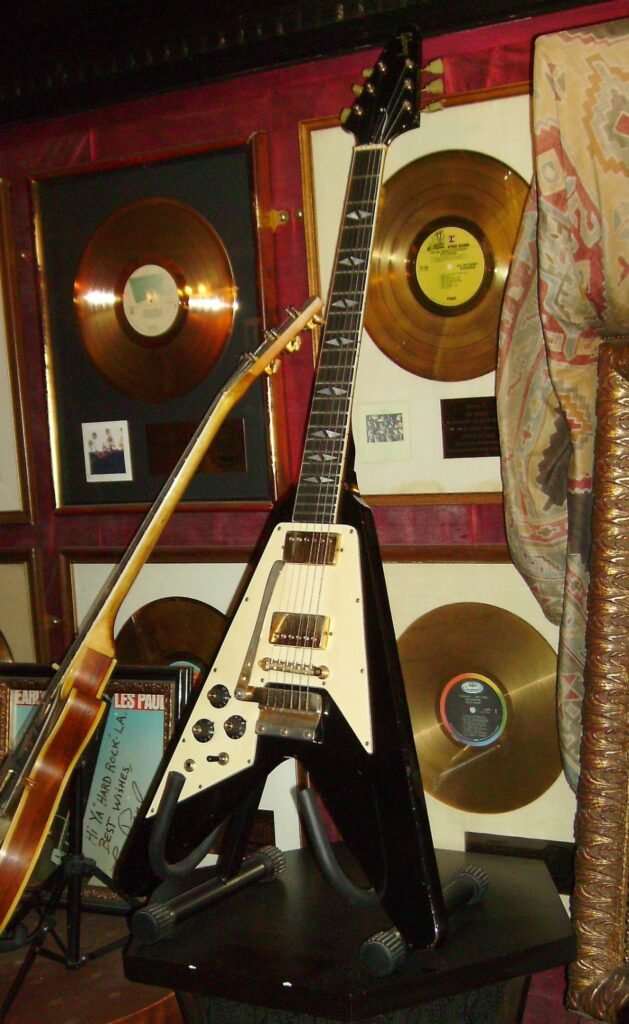
By Mike Cattell – originally posted to Flickr as Jimi Hendrix’s Flying V Gibson Guitar, CC BY 2.0, https://commons.wikimedia.org/w/index.php?curid=8718076
Intelligence sourced via CGEN Intelligence Engine. Full market report available at the CGEN Archives.




Leave a Reply